
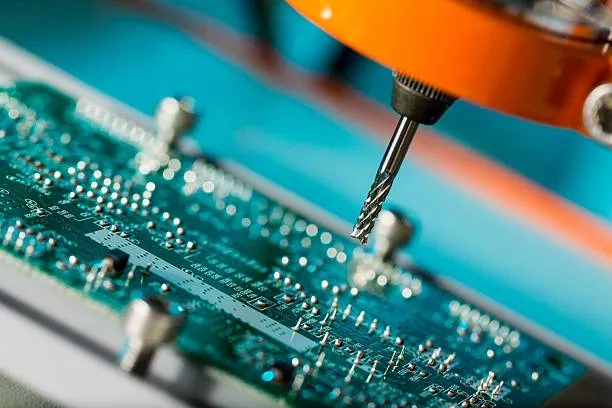
Micro-drilling CNC strategies have become a foundational manufacturing technology in the global semiconductor and advanced electronics industries, particularly for the production of printed circuit board via holes that enable high-density interconnection and signal transmission. As modern electronic devices continue shrinking in size while increasing in computational power, PCB layouts now demand extremely small via diameters, high aspect ratios, and perfectly aligned multi-layer interconnections. These requirements leave virtually no margin for error, as even microscopic deviations in hole diameter, depth, or wall integrity can lead to signal loss, impedance mismatch, thermal failure, or complete circuit breakdown. CNC micro-drilling transforms these demanding design requirements into scalable manufacturing reality by combining ultra-high spindle speeds, micron-level positioning accuracy, and digitally controlled feed synchronization. Semiconductor PCBs often contain tens of thousands of via holes per panel, each requiring identical geometry, smooth internal walls, and precise alignment across multiple copper layers. The ability of CNC micro-drilling systems to reproduce these features with absolute consistency directly determines the electrical reliability, thermal stability, and long-term performance of the end product. As consumer electronics, automotive electronics, 5G infrastructure, and artificial intelligence hardware expand rapidly, the accuracy and efficiency of CNC micro-drilling strategies continue to define competitive advantage within the semiconductor manufacturing ecosystem.
The core technical challenge of micro-drilling for semiconductor PCB via holes lies in managing extreme dimensional precision at ultra-small tool diameters while maintaining productivity and minimizing tool breakage. Micro-drills typically range from less than one hundred microns to a few tenths of a millimeter in diameter, making them highly sensitive to vibration, runout, tool wear, and axial load fluctuations. Any inconsistency in spindle concentricity, feed rate stability, or material homogeneity can instantly result in drill fracture or hole deformation. Advanced CNC systems address this challenge through ultra-high-speed spindles capable of exceeding one hundred thousand revolutions per minute, combined with closed-loop servo control that synchronizes plunge depth with rotational speed at sub-micron resolution. Real-time spindle load monitoring allows immediate detection of abnormal cutting conditions, enabling instantaneous feed reduction or cycle interruption before tool failure occurs. Tool geometry and coating technology also play a critical role, with nano-grain carbide substrates and ultra-thin diamond-like coatings enhancing edge sharpness, heat resistance, and wear life. These technological integrations allow manufacturers to maintain consistent hole profiles across thousands of drilling cycles while preserving the structural integrity of both the tool and the PCB substrate.
Material behavior further complicates CNC micro-drilling strategies for semiconductor PCB via holes, as modern circuit boards utilize complex multi-layer composites that combine copper foils, resin systems, fiberglass reinforcement, and specialized dielectric materials. Each layer responds differently to cutting forces, heat generation, and chip evacuation, making uniform hole formation extremely difficult without precise process control. If cutting parameters are too aggressive, resin smear can contaminate copper layers and degrade electrical conductivity. If parameters are too conservative, excessive friction and heat buildup can cause localized delamination, micro-cracking, or glass fiber pull-out. Advanced micro-drilling strategies solve these challenges through optimized peck drilling cycles, controlled retract intervals, and micro-lubrication systems that balance cooling with debris removal. Vacuum-assisted chip extraction systems prevent re-cutting of debris inside deep vias, preserving hole wall smoothness and dimensional uniformity. Additionally, intelligent CNC software models the interaction between drill geometry, feed rate, and material composition to dynamically adjust cutting parameters as the tool transitions through different PCB layers. This adaptive process control ensures that each via hole maintains consistent electrical performance characteristics regardless of internal layer variation.
Process stability and environmental control are equally critical in achieving high-yield CNC micro-drilling for semiconductor PCB via holes. Because micro-drilling tolerances operate at the micron scale, even minimal thermal expansion of machine components can introduce unacceptable positioning errors across large drilling arrays. Modern micro-drilling machines therefore operate within climate-controlled enclosures that maintain constant temperature and humidity levels throughout extended production shifts. Precision granite machine bases, air-bearing spindles, and thermally stabilized servo drives further eliminate mechanical distortion and positional drift. Vibration isolation systems prevent external factory vibrations from propagating into the cutting zone, where they could disrupt tool engagement and compromise hole geometry. In-process inspection technologies such as laser displacement sensors and automated optical measurement systems continuously verify hole depth, diameter, and positional accuracy without interrupting production flow. This closed-loop manufacturing environment allows CNC micro-drilling systems to maintain consistent accuracy across entire production batches containing hundreds of thousands of via holes, ensuring both electrical reliability and manufacturing repeatability at scale.
From an economic and production scalability perspective, optimized CNC micro-drilling strategies directly influence manufacturing efficiency, yield rates, and total cost of ownership in semiconductor PCB fabrication. Poor drilling performance leads to high scrap rates, excessive tool consumption, rework costs, and downstream assembly failures that dramatically increase production expenses. By contrast, high-precision CNC micro-drilling enables tighter design tolerances, higher wiring density, and faster signal transmission without sacrificing manufacturing stability. Automated tool change systems, predictive tool life analytics, and autonomous drilling cells allow continuous operation with minimal human intervention, significantly reducing labor dependency while maximizing throughput. Cycle time optimization through synchronized multi-spindle drilling platforms further enhances productivity, allowing multiple vias to be drilled simultaneously with identical geometric fidelity. As PCB designs continue shifting toward finer pitches, stacked microvias, and ultra-high layer counts, manufacturers that master advanced CNC micro-drilling strategies gain the ability to serve next-generation semiconductor markets with superior reliability, lower defect rates, and faster time-to-market performance.
Looking forward, the future of CNC micro-drilling strategies for semiconductor PCB via holes is being shaped by artificial intelligence, digital twin simulation, and hybrid manufacturing integration. AI-driven process control platforms are beginning to analyze vast datasets generated from tool wear patterns, cutting force fluctuations, thermal drift, and substrate variability to continuously self-optimize drilling parameters in real time. Digital twins allow engineers to simulate micro-drilling interactions at the microstructural level before production begins, reducing development cycles for new PCB designs and minimizing costly trial-and-error setups. Hybrid laser-assisted micro-drilling technologies are also emerging, using ultra-short pulse lasers to pre-condition drilling sites and reduce mechanical tool stress during material penetration. These advancements enable even smaller via diameters, higher aspect ratios, and improved wall integrity for future semiconductor applications. As electronics continue advancing into artificial intelligence processors, autonomous vehicle systems, quantum computing, and ultra-fast communication infrastructure, CNC micro-drilling will remain one of the most vital precision manufacturing technologies sustaining the performance, reliability, and scalability of the global semiconductor industry.